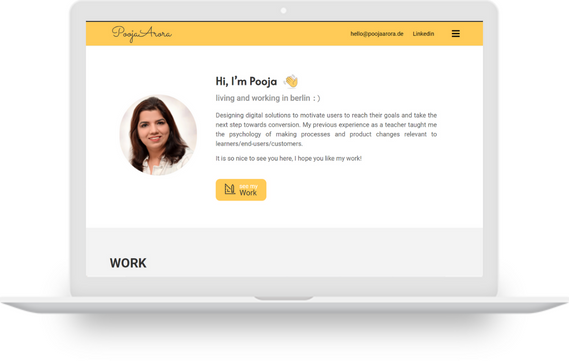
Pooja Arora is a digital designer who creates user-focused experiences that guide people towards their goals and the next step in a journey. We designed and developed her personal portfolio website on WordPress, giving her work a clean, responsive home on her .de domain.
Project overview
For a designer, the website is the first piece of work a potential client or employer judges. Recruiters and business owners often open a portfolio link between meetings, scan a few projects and decide within minutes whether to get in touch. If the site feels cluttered or slow, the designer’s skill is questioned before any case study is read.
Pooja needed a website that reflected her own design thinking: clear structure, focused content and an obvious path to contact her. It had to introduce who she is, explain how she works, present selected projects and make it simple for visitors to start a conversation.
The challenge
The core challenge was building a portfolio that proves design skill through its own experience, not just through the projects it lists.
- The site is the proof: a designer’s own website is held to a higher standard, so spacing, typography and flow had to be carefully balanced.
- Showing process, not only visuals: clients want to understand how a designer solves problems, so project pages needed room for context and reasoning.
- Short attention spans: visitors skim, so the most important work and the contact option had to appear early on every screen size.
- Adding new work easily: a portfolio grows over time, so new projects had to be addable without rebuilding pages.
Our approach
- Content planning: we worked out what a hiring manager or client looks for first and arranged the about, services and project sections in that order.
- Minimal, focused design: we used generous white space, readable type and restrained colour so the projects stay at the centre of attention.
- WordPress development: we built a dynamic site where portfolio items, text and images can be managed from the dashboard.
- On-page SEO basics: we set clear page titles, headings and descriptions so people searching for her name or services land on the right page.
- Cross-device testing: we checked layouts, links and the contact form on mobile, tablet and desktop before launch.
What we delivered
- A responsive, mobile-friendly personal portfolio website on WordPress
- A home page with a clear introduction and a direct call to get in touch
- A portfolio section for presenting selected design projects
- An about section explaining her background and way of working
- A services overview for prospective clients
- A contact form for project and job enquiries
- SEO-friendly page structure, delivered in 20 days
Technology and why we chose it
We used WordPress as the platform, writing the front end in HTML5 and CSS3 with Bootstrap for the grid, JavaScript and jQuery for interactions, and PHP with MySQL behind the scenes. Bootstrap made it straightforward to keep the minimal layout consistent from a large monitor down to a phone.
WordPress suits a working designer because publishing a new project takes minutes from the dashboard. The site can grow with her portfolio, and keeping the core and plugins updated supports long-term security.
What this project shows
- For designers and consultants, a portfolio website should follow the same principles they sell: clarity, focus and an easy next step.
- Case studies that explain the problem and the reasoning help clients judge fit better than images alone.
- A portfolio that is easy to update stays current, which matters when recent work carries the most weight.
Need a portfolio website for your personal brand? See our website design and development services or talk to our team.